

The Rise and Fall of Open Plan Living
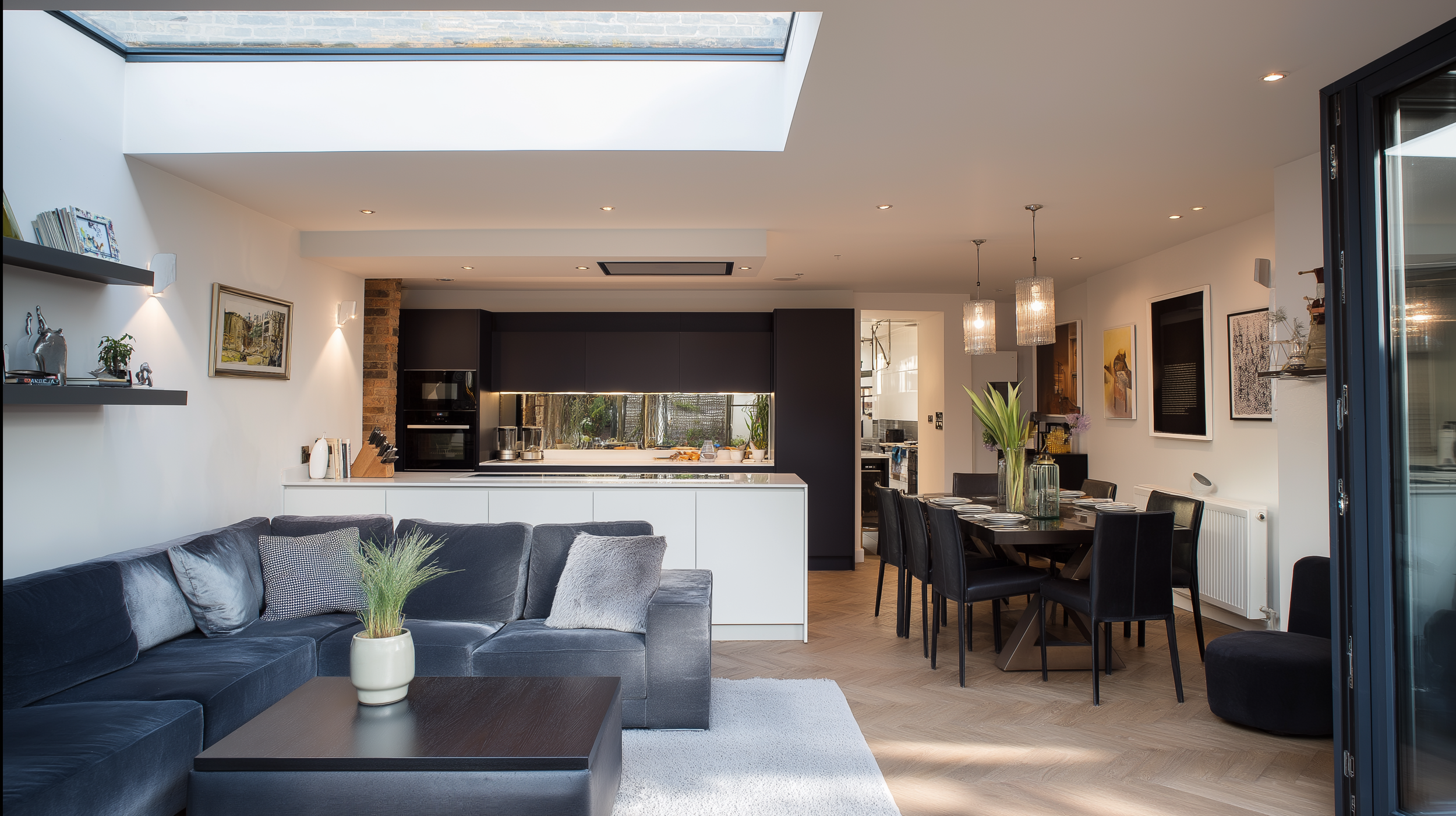
Open-plan living once defined modern British homes. It promised light, freedom and sociability. But as lifestyles evolved and households became more complex, the very openness that once felt liberating began to feel exposed. Today, many families are quietly rebuilding the walls they removed a decade ago.
There was a period in the early 2000s when it seemed every homeowner in Britain wanted the same thing: a large, open-plan kitchen and living space. Walls were knocked down with almost missionary zeal. Dining rooms were absorbed into kitchens, kitchens merged with lounges, and any hint of compartmentalisation was treated as a relic of a darker, more constrained domestic age. Estate agents leaned heavily on the phrase “bright and open,” as though light alone could solve the complexities of family life.
Open plan wasn’t merely an architectural trend. It was a cultural moment. It reflected optimism, a belief in fluidity, a sense that home life should be expansive, communal and effortlessly social. But like many ideas that gain traction quickly, it didn’t always account for the quieter realities of how people actually live.
And so here we are, some twenty years later, watching a gentle but unmistakable retreat from the open-plan ideal. Families are reintroducing separation. Glazing is returning. Bookshelves are doubling as partitions. Pocket doors are being installed where walls once stood. The movement isn’t a backlash — it’s a course correction. Open plan worked beautifully for the lives we imagined. It works less well for the lives we actually have.
The Promise of Openness
To understand why open plan became so dominant, you need to understand what it replaced. Mid-century British homes, and many Victorian ones before them, were built around separation: a kitchen tucked away at the back, a dining room for formality, a lounge reserved for evenings. Each room had a defined purpose. The layout reflected a social structure in which privacy, propriety and partitioned living were not only common but expected.
The arrival of open-plan was a rebellion against that structure. It offered:
openness instead of confinement
informality instead of formality
togetherness instead of separation
It also made practical sense. British homes, particularly in cities, are not large. Removing internal walls created the illusion of space and allowed rooms to borrow light from one another. The kitchen became a place where children could do homework while dinner was prepared. Parties became easier to host. Everyday life felt more communal.
It’s important to acknowledge that much of open-plan living still works beautifully. A well-designed open space can feel harmonious, calming and socially generous. But the enthusiasm that once accompanied the idea has softened into something more cautious.
The reason is simple: life changed.
The Household That Outgrew Its Openness
Years ago, a couple in Clapham extended the rear of their Victorian terrace to create the quintessential open-plan ground floor. At the start, the space was idyllic: sunlight across polished floors, a long island unit for gatherings, views straight out to the garden. It was exactly what they had hoped for.
Then life happened. Children arrived. One became a remote worker. The other discovered the violin. The kitchen, once the heart of sociability, became a source of noise conflict. Bedtimes clashed with cooking times. Work calls clashed with after-school energy. That sense of seamless living, once so appealing, began to feel like everyone was living on top of one another.
At some point the couple put up a piece of furniture to divide the space, “just temporarily.” Later came a glazed partition. Eventually they admitted what they had known for years: they needed fewer sight lines and more boundaries.
Their story isn’t unusual. It’s the story of hundreds of British homes.
Noise: The Great Unsolved Problem of Open Plan
The biggest flaw of open-plan living has always been acoustics. Sound loves openness. It travels with enthusiasm across hard floors, reflective walls and vaulted ceilings. A dropped spoon echoes. A conversation at one end of the room becomes background noise at the other. A simmering pot competes with a Zoom meeting. A television competes with a phone call.
When families first embraced open-plan living, remote working wasn’t common. Children weren’t expected to revise at home so intensively. The domestic environment wasn’t required to perform so many contradictory functions simultaneously.
And so the same space that once felt expansive began to feel uncomfortably exposed, sometimes even stressful. Open plan makes sense when a household shares a timetable. It works less well when everyone is living a different day in the same room.
Cooking, Smells and the Realities of Daily Life
There is also the matter of cooking — something people imagined would integrate neatly into open-plan living. In practice, kitchens are noisy, aromatic places. Extractors hum. Dishwashers rumble. Pans hiss. Even the scent of fresh food, pleasant in isolation, becomes overwhelming when it drifts into upholstery and fabrics.
Many homeowners are discovering that it’s not particularly relaxing to have the sensory experience of cooking merge with the sensory experience of resting. The romance of “cooking while socialising” doesn’t always align with the actual experience of chopping onions while someone is trying to read on the sofa.
It’s not that people don’t enjoy cooking — they just don’t want its effects to dominate the entire ground floor.
Privacy and the Need for Retreat
The more time people spend at home, the more they seek small pockets of privacy — places where they can withdraw without leaving the shared space entirely. Victorian and Edwardian homes excelled at this. A snug, a study, a quiet dining room: each room had its own mood.
Open-plan layouts tend to flatten these moods into a single broad atmosphere. That can be wonderful on a bright Saturday morning when the house is full of energy. But at 9pm on a Tuesday, after a long day, people don’t necessarily want to inhabit the same emotional space.
This is why the modern shift isn’t a return to claustrophobia but a return to nuance. People aren’t abandoning openness; they’re adding texture back into the layout.
Broken-Plan: The Middle Ground Becoming the New Normal
Broken-plan spaces - loosely divided areas that borrow light from one another but maintain some distinction - have emerged as the natural evolution of open-plan living.
These might include:
a half-height partition that defines zones without blocking sight lines
internal glazing that maintains brightness while improving acoustics
double pocket doors that can disappear on sociable days and reappear on demanding ones
bookcases used as dividers, introducing warmth and character
Broken-plan is less a design trend than a recognition of reality: homes need to adapt across multiple modes of life without forcing everyone to share the same experience all the time.
Why Open Plan Still Matters
It would be a mistake to suggest that open-plan living has “failed.” It hasn’t. It transformed British domestic life for the better, challenging old conventions and creating spaces that feel bright, social and contemporary.
But what we have now is maturity. The first wave of open plan was about removing barriers. The second wave is about reintroducing boundaries in smarter, more sensitive ways. It’s about designing homes that respond to real behaviour rather than idealised lifestyle imagery.
In many ways, British homes are becoming more interesting again precisely because the rules are being rewritten. The binary choice between open and closed is dissolving. Houses are once again allowed to have corners, edges, layers — the things that make domestic life feel textured and meaningful.
Open-plan living promised liberation: light, sociability, space. And for a while it delivered exactly that. But as home life has become more complex, the needs of households have shifted. The wide, uninterrupted ground floor is no longer the universal answer.
Homeowners today are choosing something more nuanced — spaces that can expand or contract, invite or retreat, open or close depending on the moment. The trend isn’t towards walls or openness but towards flexibility, subtlety and architectural empathy.
Open plan hasn’t died.
It has simply grown up.