

Why Planning Drawings and Construction Drawings Are Completely Different Beasts
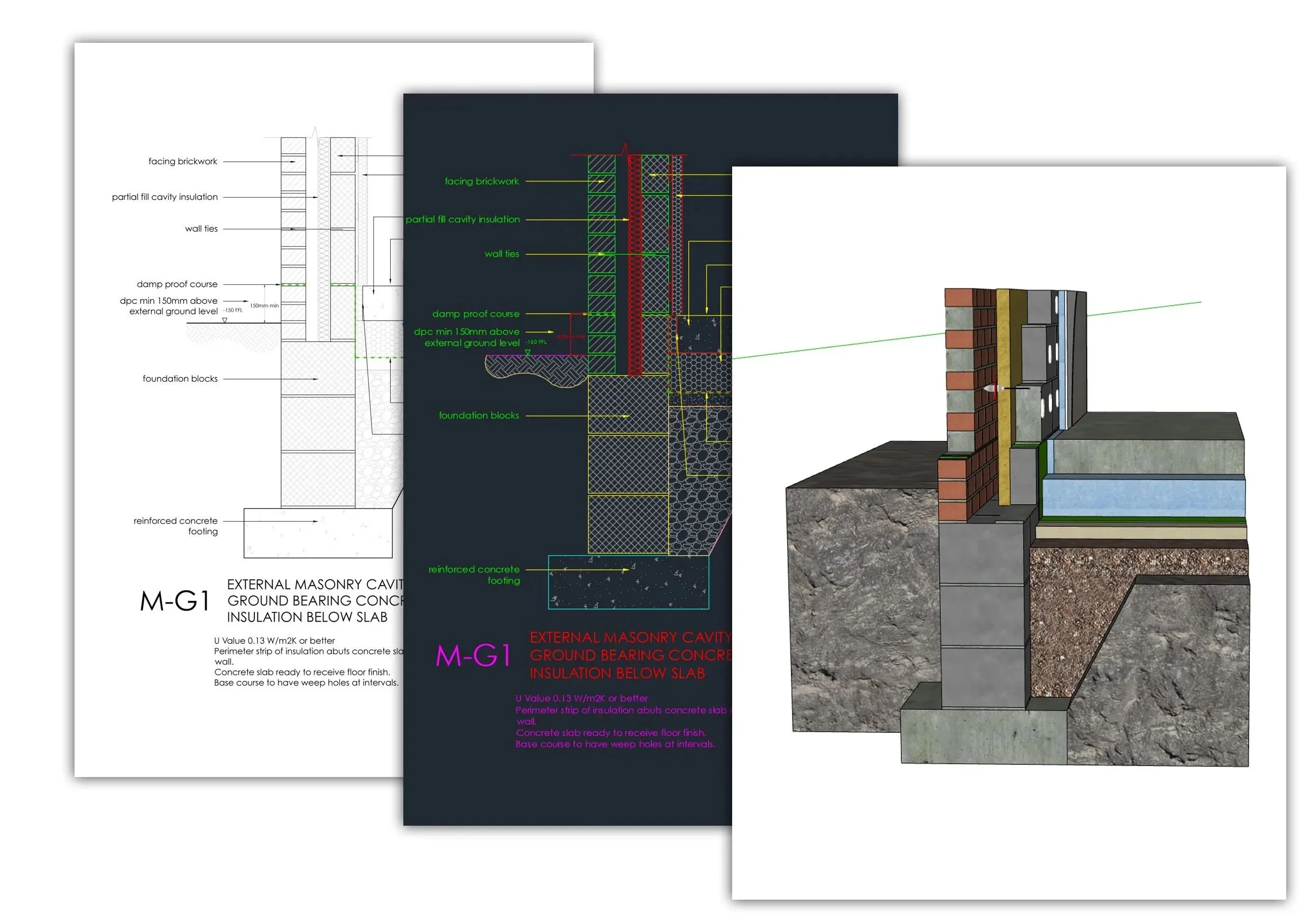
Planning drawings express an idea. Construction drawings express a reality. They may look similar at a glance, but they serve different purposes, answer different questions and operate within different worlds.
Planning Drawings Are About Permission, Not Precision
A planning drawing is, above all, a communication tool. Its purpose is to show the local authority what you intend to build and how it relates to the surrounding context. It describes a proposal rather than a final technical solution. This is why planning drawings appear simple. They show walls, openings, shapes and massing, but they do not describe the layers, materials or structural decisions needed to make the idea buildable.
Homeowners sometimes mistake this clarity for completeness. The drawing looks finished, so the design must be finished. In truth, a planning drawing is closer to a promise. It promises that the development will look a certain way. It does not yet prove how the design will work.
Planning drawings answer the question, what will this be. Construction drawings answer the question, how will it built.
Construction Drawings Are Technical Instruments
Once planning permission is granted, the nature of the drawing must change entirely. Construction drawings must describe structure, build ups, materials, tolerances, detailing, fire strategy, drainage, thermal performance and the coordination between all of the above. They must also provide answers for builders, engineers and building control officers, all of whom need information at a level of clarity far beyond what planning requires.
These drawings are covered in notes, sections and details because they are instructions rather than representations. A construction drawing carries responsibility. If it is vague, the builder must guess. If it is wrong, the building suffers. Planning drawings speak to planners. Construction drawings speak to everyone who will touch the building. The difference is not one of quantity but of purpose.
Planning Drawings Are Visual. Construction Drawings Are Legal.
A planning drawing is evaluated for compliance with policies relating to appearance, massing, conservation character and sometimes neighbour impact. It is judged aesthetically and contextually. Construction drawings, in contrast, become part of the contract and the regulatory record. They are checked for compliance with building regulations, structural logic, fire safety, waterproofing and health and safety considerations.
One drawing seeks approval of form. The other seeks approval of function. A planner may object to the height of a dormer. A building control officer will object to the lack of fire protection around it. These are different conversations taking place around drawings that share a superficial resemblance but have entirely different obligations.
The Structure Lives in the Construction Drawings
The most significant difference between the two sets of drawings is the presence of structure. Planning drawings rarely show beams, columns, lintels or load paths. They are not designed to explain how the building stands up. This is why planning drawings often appear deceptively simple. They conceal the complexity beneath the surface.
Construction drawings integrate structural design at every point where the building must resist load, movement or moisture. A steel beam may interrupt an elegant planning line. A drain may need to shift because of a foundation. A wall that appears thin in a planning drawing may require additional thickness for fire protection or insulation.
Planning drawings show intention. Construction drawings expose reality.
Information Density Increases sharply Post Planning
Between planning approval and construction information lies a large philosophical shift. During planning, clarity is achieved through simplicity. After planning, clarity is achieved through detail. Builders need precise instructions. Engineers need dimensions, levels and load points. Building control needs specifications. Every decision must be recorded.
It is at this point that homeowners realise that the drawings have multiplied. What began as five sheets may expand into fifty, each serving a different purpose. This is not complication for its own sake. It is the unavoidable process of translating an idea into a buildable form.
Planning Drawings Never Show the Full Story
Homeowners sometimes express frustration when construction drawings appear to contradict the planning drawings. Walls move slightly. Roof thickness grows. Windows shrink a fraction. Doors align differently. These changes do not represent mistakes. They represent the layering in of technical requirements, such as insulation thickness, drainage runs, minimum headroom, fire protection zones and structural restraints.
Planning drawings simplify the world so it can be assessed. Construction drawings reveal the world so it can be built. The two cannot be identical without sacrificing accuracy in one or clarity in the other. The drawing set that wins permission cannot be the same drawing that guides construction.
Why Builders Cannot Build From Planning Drawings
Builders who attempt to build from planning drawings do so by guesswork. They must interpret what was not shown. Guessing is not a sign of creativity but a symptom of missing information. Without technical drawings, a builder decides where structure should go, how waterproofing should be implemented, what tolerances to allow and how services should run.
This creates risk for the homeowner. The builder becomes the designer, whether intentionally or not. Structural decisions become site decisions. Compliance becomes uncertain. The builder is placed in the position of solving problems that should have been resolved before the project began.
Planning drawings are pictures. Construction drawings are instructions, and Builders need instructions.
The Two Drawing Types Reflect Two Phases of Thinking
Planning is a conceptual exercise. It shapes the idea. Construction is a technical exercise. It gives the idea form. The boundary between the two is sharp because each phase asks different questions and demands different answers.
Planning asks whether the building belongs in its setting. Construction asks whether the building can stand. Planning drawings focus on scale, proportion and appearance. Construction drawings focus on performance, stability, durability and safety. The difference is not a matter of style or draughtsmanship. It is a shift in responsibility. One drawing persuades. The other guarantees.
Planning drawings and construction drawings are often confused because they share a visual language, but they belong to different worlds. The first exists to gain permission. The second exists to express truth. When homeowners understand this divide, the process becomes far more legible. A building must be imagined before it is engineered. The drawings reflect that journey.